In short
Polyurethane foam, including memory foam, forms when a polyol reacts with a diisocyanate such as TDI or MDI. Water, catalysts and surfactants make it rise. A CertiPUR-US label means accredited labs checked the foam for formaldehyde, regulated phthalates, heavy metals, listed flame retardants and ozone depleters. Its total VOC emissions also had to stay under 0.5 mg/m³ after 72 hours. The label covers the foam alone. The cover fabric, any fiber mixed into shredded fill, and any finish are outside it.
This guide is for: anyone with a foam pillow, topper or mattress pad who wants to know what the foam is made of and what its label promises.
Key Takeaways
- We read 8 seller pages for shredded memory foam pillows and fill on 2026-11-17. 5 of them name CertiPUR-US but don't say what it checks.
- CertiPUR-US caps the foam's total VOC emissions at under 0.5 mg/m³, measured in a test chamber after 72 hours.
- A 2022 study followed 2 new memory foam mattresses. Emissions peaked within a day, and the modeled one-year averages were 2.7 and 4.2 μg/m³.
What is polyurethane foam made of?
Polyurethane foam is a plastic made by reacting a polyol with a diisocyanate, while water, catalysts and surfactants make it rise into foam.
Every soft foam in your pillow, topper or mattress pad starts as two liquids. They set when they meet. One is a polyol, a thick liquid that forms long, bendy chains. The other is a diisocyanate, most often TDI or MDI. A study indexed by the EPA describes a flexible foam made from TDI and a polyether polyol. What you rest your head on is the solid plastic those two liquids become.
| Ingredient | What it does in the foam |
|---|---|
| Polyol | Forms the long, bendy chains that make the foam soft |
| Diisocyanate (TDI or MDI) | Links the polyol chains into a solid network |
| Water | Reacts to release carbon dioxide, which blows the bubbles |
| Catalysts | Speed the reaction so the foam sets before it collapses |
| Surfactants | Keep the bubbles even in size |
Water reacts during the mix and gives off a gas, so the foam swells as it sets. When the reaction ends, you are left with a solid, not a liquid. Your real question is what traces stay behind. A risk assessment indexed by the EPA looked at leftover TDI in mattress foam. It found that sleeping on a PU foam mattress does not pose TDI-related health risks. That study looked at mattresses, so take it as a guide for your pillow rather than a pillow test. The chemicals people ask about most are the add-ins, such as flame retardants, and the gases new foam gives off. You'll find both further down this page.
What does a CertiPUR-US label test the foam for?
It checks the foam for a fixed list: formaldehyde, regulated phthalates, heavy metals, certain flame retardants, ozone depleters and total VOCs.
CertiPUR-US is a voluntary program run by a nonprofit, according to the program's page on its testing. Foam makers send samples to accredited labs, and those samples have to meet published limits. A label on your pillow means the foam inside passed this list, and nothing broader.
| What is checked | The rule as the program or a seller states it | Source |
|---|---|---|
| Total VOC emissions | Under 0.5 mg/m³ at 72 hours in a test chamber | Seller's summary of the program |
| Formaldehyde | Made without it, confirmed by a small chamber test | Seller's copy of the program text |
| Phthalates | Made without the ones the CPSC regulates | CertiPUR-US |
| Lead and other heavy metals | Meets the CPSC toy standard for lead | CertiPUR-US |
| Flame retardants | No PBDEs or the Tris chemicals TCEP, TDBPP, TDCPP or TEPA | CertiPUR-US |
The program's own page says foam samples are conditioned before total VOC emissions are measured. It states the cap in parts per million. Some seller summaries, like the one in the table, give it in mg/m³ instead. Those are two different units. You can't convert one to the other without knowing which gases are in the air, so don't read them as a match. The seller's copy of the program text adds that formaldehyde has never been used as a raw material in foam. That check confirms something is missing. It doesn't catch a common ingredient.
What do memory foam pillow sellers say the label means?
Of the eight seller pages we read for this guide, five name the label without saying what it checks, two explain it, and one claims more.
Our count covers 8 seller pages for shredded memory foam pillows and loose pillow fill, read on 2026-11-17. For each page, we recorded what it says the CertiPUR-US label means.
5 of the 8 name the label and say nothing about what it checks.
2 of the 8 explain it in the program's own terms, as limits on content and emissions.
1 of the 8 claims more than the program checks, calling the foam hypoallergenic and anti-bacterial.
| Seller page | What the page says the label means | Bucket (our judgement) |
|---|---|---|
| Layla Memory Foam Pillow | Foams certified; fabric carries a separate OEKO-TEX label | Names it only |
| GhostPillow Shredded | Certified foam blended with microfiber | Names it only |
| Foam by Mail pillow | Foam meets the certification | Names it only |
| Airpedic gel fiber pillow | Certified memory foam | Names it only |
| Custom Comfort pillow | Certified | Names it only |
| Foam Order shredded fill | Certified for content, emissions and durability | Explains it |
| Bamboo Is Better refill | Low-VOC, tested to emission and content standards | Explains it |
| Lounj shredded fill | Safe, non-toxic, hypoallergenic, anti-bacterial | Claims more |
Only one of the eight names any certificate for the cover fabric. If you shop from most of these pages, you see the seal and learn little else. You have to go to the program's list to find out what the seal means. These are counts of what the pages say. We had none of the foam in hand.
Which parts of a foam pillow does the label leave out?
The label covers the polyurethane foam alone, so the cover fabric, any fiber blended into the fill, zippers and finishes need their own checks.
The label belongs to the foam, not to the product you buy. One mattress seller's FAQ says the certification is held by the foam manufacturer and applies to the foam inside, not the finished product. Another seller's help page adds that adhesives, flame barriers, antimicrobial treatments, and other components aren't covered. On a pillow, most of what touches your face sits outside the label.
| Part of the pillow | Covered by CertiPUR-US? | What would cover it |
|---|---|---|
| Polyurethane foam pieces | Yes | The CertiPUR-US label itself |
| Polyester or gel fiber mixed into the fill | No | A textile label, if the seller names one |
| Cover fabric | No | A textile label such as OEKO-TEX STANDARD 100 |
| Water-repellent or antimicrobial finish | No | The seller's own statement of what was applied |
| Emissions from the finished pillow | No | A finished-product emissions certificate |
Shredded pillows often mix foam with fiber. GhostBed sells a blend of certified shredded memory foam and microfiber, and that fiber isn't polyurethane foam. For your pillow's cover, our guide to what STANDARD 100 tests bedding for explains the usual textile check. If your cover is sold as waterproof, our PFAS guide covers what may be on it. Finally, how GOTS (the Global Organic Textile Standard), OEKO-TEX, GREENGUARD and MADE SAFE differ shows which labels reach the finished product.
Why does the label still list flame retardants the US stopped making?
PentaBDE left US production more than two decades ago, but imported goods can still carry it, which is why a foam check for it still matters.
Flame retardants used to be mixed straight into furniture and mattress foam. The EPA says pentaBDE was widely used as an additive in furniture foam to meet flammability rules. US production of pentaBDE and a related chemical ended at the end of 2004, according to the EPA's rule page. Your exposure didn't stop when US production did. The EPA notes that pentaBDE may still be used in other countries and may enter the US in imported goods.
The program bars PBDEs and the Tris flame retardants TCEP, TDBPP, TDCPP and TEPA, per its testing page. A seller's copy of the program text adds a broader rule. No flame retardant may be used that the Globally Harmonized System (GHS) classes as a likely cause of cancer, genetic defects or harm to fertility. Read that rule closely. It bars named and classified chemicals, not every flame retardant.
A seller's FAQ on the program says only the maker of the foam product can tell you whether it is free of flame retardants. So the label tells you which chemicals are out of your pillow's foam, and the seller has to tell you the rest. If you want a pillow with no flame retardants at all, ask the seller to say so in writing.
How much does new memory foam give off, and for how long?
Emissions from new memory foam peak within the first day and then fall, according to a recent study that tracked two mattresses for about a month.
New foam smells because making it leaves small, light molecules behind, and they escape into your room as gas. The Sleep Foundation notes that VOCs are a byproduct of making synthetic foam. The clearest published figures come from a study in the journal Chemosphere, recorded by the EPA. Its authors set up two new memory foam mattresses in a space built to copy home use and sampled the air for about a month. Emissions peaked within a day of setup and fell from there.
The modeled one-year averages for total VOCs were 2.7 and 4.2 μg/m³. The authors judged these well below health-based benchmarks for the single chemicals they found.
Two cautions apply to your pillow. First, the study measured mattresses, and our search turned up no study like it on pillows. A pillow holds much less foam, but it sits right by your nose. Second, the chamber limit behind a CertiPUR-US label isn't a room reading. You can't compare it straight across with the study's figures. The timing is what carries over to you. A new pillow gives off the most in its first days, so that is when airing it in a room with an open window helps most.
How is memory foam different from the foam in a couch cushion?
Memory foam is a slow-recovery polyurethane foam that softens with warmth, and the label checks it like any other flexible foam.
Memory foam is still polyurethane. The Polyurethane Foam Association's bedding history says it came out of NASA's Ames Research technology transfer program. It also says the foam is known for its slow recovery after you press it. Push your hand in and the dent fills back slowly, not all at once.
A seller's materials page says memory foam softens in response to body heat and pressure. That is why your head sinks in a little more as the pillow warms. Memory foam is flexible polyurethane, so a memory foam pillow is checked against one CertiPUR-US list, just as a couch cushion is.
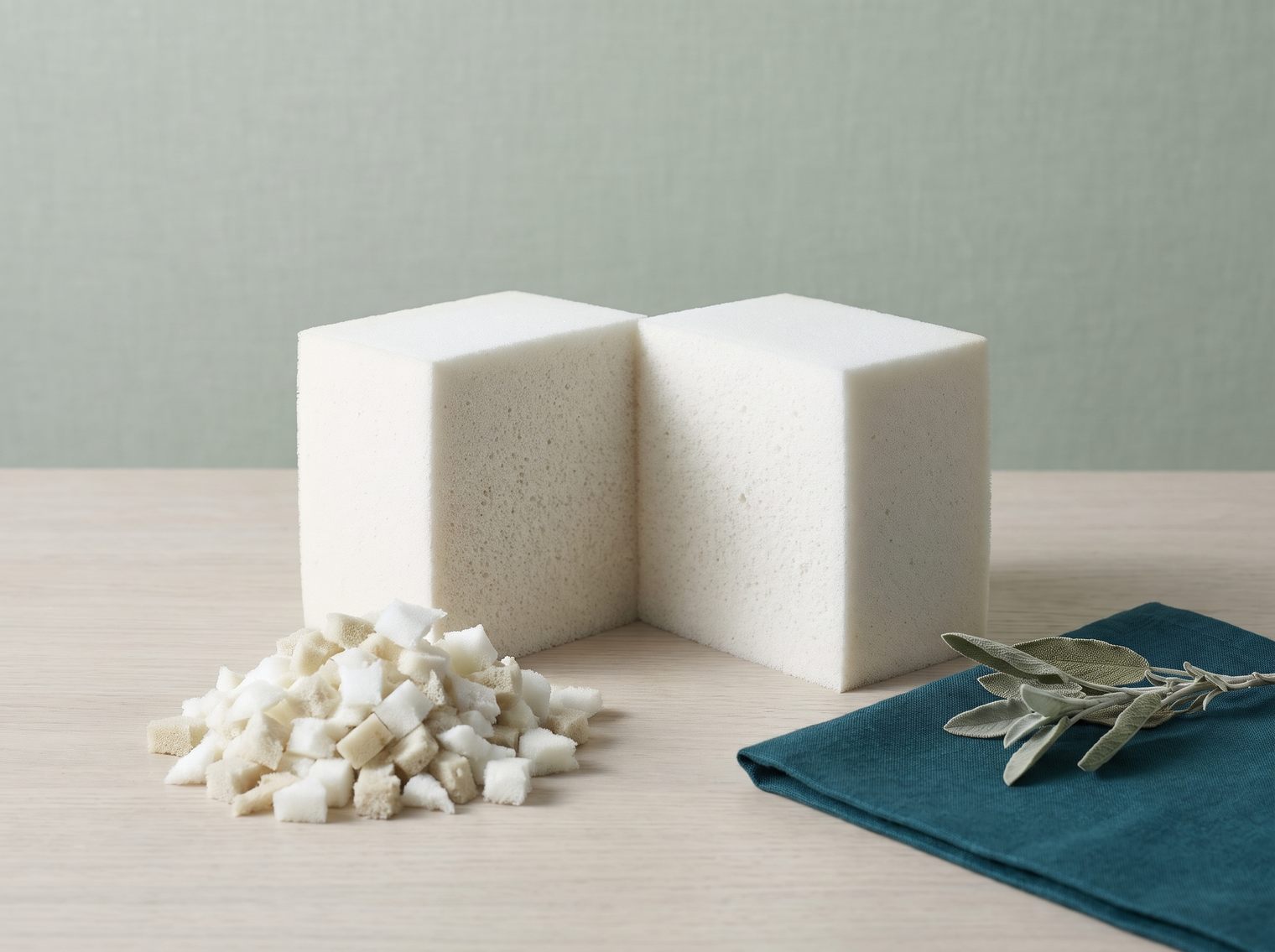
Couch foam and memory foam differ in feel, not in base chemistry. Couch foam is made to spring back quickly. Memory foam is made to hold your shape for a moment before it lets go. Shredded memory foam is memory foam cut into small pieces. You can take fill out or add it to change your pillow's height. When the shreds carry the label, the label applies to the pieces only. It doesn't extend to the pillow they fill, or to any fiber mixed in with them. If you see the seal on a shredded pillow, read it as a promise about the foam pieces and nothing more.
How can you check whether a foam pillow's label is real?
Look up the foam maker in the CertiPUR-US directory, since certified foam has to be tested again twice in its first year and then every year.
A seal on a product page is the seller's claim, and the directory is where you check it. The program's testing page says foams must be certified twice in the first year and annually after that. The certificate belongs to the foam maker, so the brand you bought from may not appear in the directory. If it doesn't, ask the seller which company made the foam.
A short routine works for most pillows:
- Read the exact wording. A mattress review guide notes that the accurate wording is that a product contains CertiPUR-US certified foam, not that the whole product is certified.
- If your pillow brand isn't listed, ask the seller for the foam maker's name.
- Search that name in the directory on the CertiPUR-US site.
- Check the cover and any fiber blend on their own, because the foam label says nothing about them.
If a page uses the label to claim more than the program's list, treat the extra claims as the seller's own words. You can still buy the pillow. You'll just know which parts of the promise the label stands behind, and which parts rest on the seller alone.
Common questions
Does a CertiPUR-US label mean a memory foam pillow is non-toxic?
It means the foam met one fixed list of limits. The program's list names specific substances and an emissions cap. It says nothing about the cover, the fiber or any finish.
Is a cap in parts per million the same as one in mg/m³?
No. They're different units. The program's own page gives the cap in parts per million, while some seller summaries give it in mg/m³, and you can't swap one for the other.
Does CertiPUR-US apply to latex pillows?
No. A seller's help page states that CertiPUR-US does not apply to or test latex foams. If you see the logo, the product contains polyurethane foam.
Will a certified foam pillow still smell when it is new?
It can. Low emissions aren't zero, and the mattress study above found emissions peaked on the first day. Airing your pillow in an open room during its first days helps.
Is shredded memory foam a different material from a solid memory foam pillow?
No. Shredded fill is memory foam cut into pieces, and it's often mixed with polyester fiber. The label covers only the foam pieces in that blend.
Does CertiPUR-US check how long the foam lasts?
Yes, in part. The program says it sets standards for content, emissions and durability. The chemistry limits in the table above are the part most sellers mention.
Sources behind this entry
Each outside document this entry relies on, in the order it is first cited, with the part of the entry that cites it.
- indexed by the EPA (hero.epa.gov), cited in “What is polyurethane foam made of?”.
- risk assessment indexed by the EPA (hero.epa.gov), cited in “What is polyurethane foam made of?”.
- the program's page on its testing (certipur.us), cited in “What does a CertiPUR-US label test the foam for?”; “Why does the label still list flame retardants the US stopped making?”; “How can you check whether a foam pillow's label is real?”.
- Seller's summary of the program (embrsleep.com), cited in “What does a CertiPUR-US label test the foam for?”.
- Seller's copy of the program text (dreamlandsleepshop.com), cited in “What does a CertiPUR-US label test the foam for?”; “Why does the label still list flame retardants the US stopped making?”.
- CertiPUR-US (certipur.us), cited in “What does a CertiPUR-US label test the foam for?”; “How can you check whether a foam pillow's label is real?”.
- Layla Memory Foam Pillow (laylasleep.com), cited in “What do memory foam pillow sellers say the label means?”.
- GhostPillow Shredded (ghostbed.com), cited in “What do memory foam pillow sellers say the label means?”.
- Foam by Mail pillow (foambymail.com), cited in “What do memory foam pillow sellers say the label means?”.
- Airpedic gel fiber pillow (airpedic.com), cited in “What do memory foam pillow sellers say the label means?”.
- Custom Comfort pillow (customcomfortmattress.com), cited in “What do memory foam pillow sellers say the label means?”.
- Foam Order shredded fill (foamorder.com), cited in “What do memory foam pillow sellers say the label means?”.
- Bamboo Is Better refill (bambooisbetter.com), cited in “What do memory foam pillow sellers say the label means?”.
- Lounj shredded fill (lounjbedding.com), cited in “What do memory foam pillow sellers say the label means?”.
- FAQ (endy.com), cited in “Which parts of a foam pillow does the label leave out?”.
- help page (help.avocadogreenmattress.com), cited in “Which parts of a foam pillow does the label leave out?”.
- EPA (epa.gov), cited in “Why does the label still list flame retardants the US stopped making?”.
- EPA's rule page (epa.gov), cited in “Why does the label still list flame retardants the US stopped making?”.
- seller's FAQ on the program (loungedoctor.com), cited in “Why does the label still list flame retardants the US stopped making?”.
- Sleep Foundation (sleepfoundation.org), cited in “How much does new memory foam give off, and for how long?”.
- recorded by the EPA (hero.epa.gov), cited in “How much does new memory foam give off, and for how long?”.
- Polyurethane Foam Association's bedding history (pfa.org), cited in “How is memory foam different from the foam in a couch cushion?”.
- materials page (help.avocadogreenmattress.com), cited in “How is memory foam different from the foam in a couch cushion?”.
- mattress review guide (sleepranked.com), cited in “How can you check whether a foam pillow's label is real?”.
Change log
- : first published